
Dear valued customer,
What happens in our plants starts with what comes in. The composition and quality of waste streams have a direct impact on the incineration process, our emissions and the residual materials that remain after processing. In this newsletter, we share several examples of how this affects our day-to-day operations.
We are currently investigating why we are seeing a relative increase in the amount of bottom ash remaining after incineration and whether this may be related to an increase in construction and demolition waste residues in incoming waste streams. At the same time, we continue to find solutions for waste streams that require a different approach. Our new solution for processing vapes, which we can now offer together with our subsidiary Milieuwerk, is a good example.
We also want to continue hearing how you experience our services. This month, we are launching our biennial customer satisfaction survey. I hope you will take the time to share your experiences and suggestions with us. Your feedback helps us understand what we are doing well and where we can improve.
Finally, process technologist Jonhatan Lorenzo Mercado takes you behind the scenes at AEB. Drawing on his day-to-day work, he explains just how much waste quality affects our plants and residual materials – and shares the remarkable journey that brought him from Mexico to AEB.
Wim van Lieshout
CEO AEB Amsterdam
How do you experience working with AEB? In September, we are launching our biennial customer satisfaction survey in collaboration with research and consultancy firm Integron. Your experiences and suggestions help us understand what is going well and where we can further improve our services.
We will invite both operational contacts and managers from our Dutch and international customers to participate. The survey focuses on the services we provide to customers who deliver waste to AEB.
Your feedback helps us improve
What are we doing well, and where can we improve? We are interested in your experiences, your assessment of our services and, above all, your suggestions for improvement. The results will help us identify opportunities and develop targeted improvement actions, so that we can continue to support you as effectively as possible.
Invitation in September
In the second half of September, you will receive a personal invitation by email from Integron, including a link to the questionnaire. Completing the survey will only take a few minutes.
Your anonymity is guaranteed. Only if you explicitly give your consent can your responses be shared with AEB under your name for targeted follow-up.
We hope you will take part. Thank you in advance for your time, involvement and valuable feedback. Together, we can continue to improve our services and build a sustainable long-term partnership.


From Mexico City to Amsterdam, with a nearly 3,900-kilometre cycling trip along the way. Process technologist Jonhatan Lorenzo Mercado talks about how he found his way to AEB, what fascinates him about waste and why its composition makes such a difference.
Jonhatan Lorenzo Mercado grew up in Mexico City, a metropolis with more than 22 million inhabitants. At the age of seventeen, he left Mexico to study in Europe. He applied to several universities and eventually chose Groningen. He later studied Chemical Engineering at Delft University of Technology, graduating in 2019.
After completing his studies, Jonhatan worked in the oil and gas industry for more than three years. He then took a year off and got on his bike. Together with a friend, he cycled from Sweden to Turkey: a journey of almost 3,900 kilometres.
“The trip took about three months. We didn’t cycle every day. Sometimes we stayed somewhere a little longer, for example in Croatia or Austria, simply because it was so beautiful.”
The trip also played a part in his decision to join AEB. Along the way, Jonhatan saw enormous quantities of waste in various places. It made him curious about how we deal with waste in Europe. Once back in the Netherlands, he started learning more about waste processing. Through a friend who was already working at AEB, he eventually found his way to the company.
“I discovered that for non-recyclable waste, converting it into energy can be a better option than sending it to landfill. The combination of circularity, technology and energy immediately appealed to me.”
No two days are the same
Jonhatan has now been working as a process technologist at AEB for two years. His main responsibility is optimising flue gas cleaning: keeping emissions within permitted limits while reducing the use of chemicals as much as possible.
He is also involved in waste acceptance, CO₂-related issues and residual materials.
“I never expected to be working on CO₂ levies, waste from Italy or finding better destinations for gypsum. That variety is exactly what makes my job interesting.”
His working day usually starts by reviewing the operators’ reports. This may be followed by meetings about waste quality, investigations into process deviations, optimisation projects or practical tests. Jonhatan works with almost every part of the organisation, from Sales, operators and Maintenance to Engineering, Safety and the residual materials coordinators.
Waste quality makes a difference
An important part of Jonhatan’s work is the quality of the waste received by AEB. Its composition largely determines how well the plant can operate.
Waste containing high levels of chloride or sulphur, for example, requires more chemicals for flue gas cleaning. Metals, moisture content and calorific value also affect the process. If waste is too wet or has too high an energy content, it can disrupt the incineration process. Its composition also affects the quality of the residual materials.
“The better the quality of the waste, the better the quality of the bottom ash in the end.”
Preferably no PVC
One material Jonhatan is seeing more frequently in waste streams is PVC. It contains high levels of chloride, which means more chemicals are required for flue gas cleaning while at the same time more residue is produced. This results in additional costs at both ends of the process.
AEB therefore carefully checks the waste streams offered for processing. Waste streams are assessed on the basis of analyses, regulations and agreements with the customer. Physical inspections are also carried out, and the acceptance team reviews the relevant documentation. If a load does not match the agreed waste stream, acceptance may be stopped.
Maintenance and safety are also important considerations. High chloride levels can lead to increased corrosion. Very dusty waste causes additional contamination and maintenance and, in certain situations, may create an explosion hazard. Certain volatile substances can also pose risks to employees.
Jonhatan’s advice to customers is clear:
“Above all, try to keep PVC out of the waste stream. That alone would make a significant difference.”
Europe has a waste problem too
According to Jonhatan, there is a persistent misconception that major waste problems mainly occur far away.
“Many people associate major waste problems with countries such as India or China. But Europe has a waste problem too. It is closer to home than we often think.”
In his view, landfilling waste is not a sustainable solution, partly because landfill sites contribute to methane emissions. But the answer is not simply to process waste more effectively.
“We shouldn’t only look at how we process waste, but also at how we can reduce the amount of waste we produce in the first place.”
Solving problems together
One project Jonhatan is particularly proud of is reducing leaks in the filter installations. Together with colleagues from Maintenance and Production Engineering, he investigated the various causes and addressed them step by step.
“We are now seeing far fewer incidents. I’m really proud of that.”
Looking ahead, he sees CO₂ and residual materials as two of the main challenges. The CO₂ levy makes it increasingly important for AEB to remain competitive for both domestic and international waste streams. At the same time, the aim is to find the best possible applications and destinations for residual materials.
At home in the Netherlands
Jonhatan has now lived in the Netherlands for twelve years. He has lived in Groningen, Delft, Utrecht, Rotterdam and Amsterdam, although one city holds a special place for him.
“People in Amsterdam might not like hearing this, but I felt most at home in Rotterdam. It reminds me a little of Mexico City. And you can even take the metro all the way to the beach at Hoek van Holland.”
He also appreciates Dutch working culture, particularly the work-life balance. In Mexico, he saw his father sometimes work from nine in the morning until nine at night. Jonhatan wanted something different for himself.
“In the Netherlands, my working hours are respected. I also like the fact that people are direct. They simply say what they think, which means you can move forward more quickly.”
What he still misses after all these years is his native language and the warmth of Mexican culture.
“I miss speaking Spanish. You’re never quite as funny or as quick-witted in another language as you are in your mother tongue. Dutch people are warm too, but sometimes it takes a little longer before you see that side of them.”
“Don’t be afraid to ask questions”
One thing that pleasantly surprised Jonhatan at AEB is how much colleagues do together outside work, from volleyball and padel to bouldering.
At work, colleagues are always welcome to approach him too. With a smile, he describes his broad range of responsibilities as a collection of “side quests”.
“I like helping people, so you can always come and ask me.”
Jonhatan at a glance
🇲🇽 Born in: Tampico, Tamaulipas, Mexico
📍 Lives in: Amsterdam
👷 Role: Process Technologist
📅 At AEB since: 2024
🍽 Favourite food: Huauzontles – a traditional Mexican vegetable
from the amaranth family, similar to broccoli
🚴 Hobby: Bikepacking
🌍 Favourite place in Mexico: Mérida, Yucatán
💬 Life motto: We live in borrowed time.
♻️ Tip for better waste quality: Keep PVC out of the waste stream
as much as possible.
Do you have a batch of vapes that needs to be processed? You can now arrange this through AEB. Previously, we were unable to accept this waste stream because of the batteries. Thanks to our collaboration with our subsidiary Milieuwerk, we can now take care of the entire process for you.
Vapes contain batteries that first need to be separated from the other materials. The batch is therefore transferred via AEB to Milieuwerk, where the batteries are separated. The batteries are then sent via WEEE NL and Stichting OPEN for further processing and recycling. The remaining waste is processed at AEB.
One point of contact
AEB remains your single point of contact. You register the batch with us and we take care of the rest. There is no need for you to find another waste processor or set up a new supplier.
Safe and responsible processing
Separating the batteries not only supports recycling, but also helps prevent batteries from entering the regular waste stream, where they can cause fires.
Our collaboration with Milieuwerk also has a social dimension. The sorting work provides employment opportunities for people who face barriers to entering the labour market.
The volumes involved can be substantial: this year alone, Milieuwerk has already sorted eight trailer loads of vapes for further processing.
Do you have a batch of vapes that needs to be processed? Contact your AEB representative. We will take care of the rest.


Since 2023, AEB has observed a concerning development: after incineration, we are left with a relatively increasing amount of bottom ash. This may indicate that incoming waste contains more non-combustible components. At the same time, chloride and sulphate levels in the bottom ash are approaching the limits for effective processing.
These developments may be related to an increase in construction and demolition waste residues in incoming waste. AEB has launched an investigation to determine whether this is indeed the case.
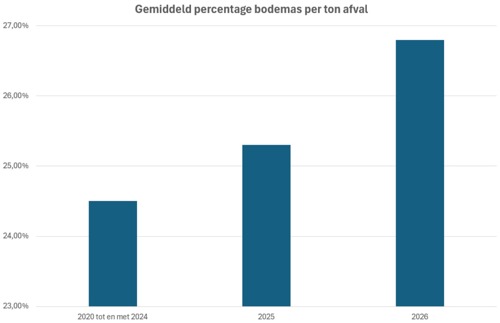
Finding outlets for bottom ash is becoming increasingly difficult
The increasing amount of bottom ash presents an additional challenge, as finding outlets for it is also becoming more difficult and costly. Opportunities to use bottom ash in infrastructure projects are limited, and alternative materials such as gravel are increasingly preferred.
In addition, the chloride and sulphate levels in the bottom ash are approaching the limits applied by one of our customers for effective processing.
Investigation into construction and demolition waste residues
The combination of an increasing proportion of bottom ash, non-combustible components and the presence of chlorides and sulphates may indicate a higher proportion of construction and demolition waste residues.
We are therefore investigating whether more construction and demolition waste residues are indeed being delivered, which waste streams they occur in and where they originate.
Additional checks
In the coming period, we will carry out additional checks on incoming waste streams for the presence of construction and demolition waste.
Once the results of the investigation are available, we will inform our customers about the findings and what they mean for the waste streams concerned.

Looking for a reliable used stationary waste compactor? AEB is offering Husmann MP 1000 TS stationary waste compactors for sale. These robust machines are designed for the efficient compaction of a wide range of waste streams.
The available configuration consists of two stationary waste compactors with 32 hook-lift containers. Delivery of one stationary waste compactor with 16 hook-lift containers is also possible.
Full specifications, photographs and contact details are available on the sales page.
Sales page